Intro to Native Plants
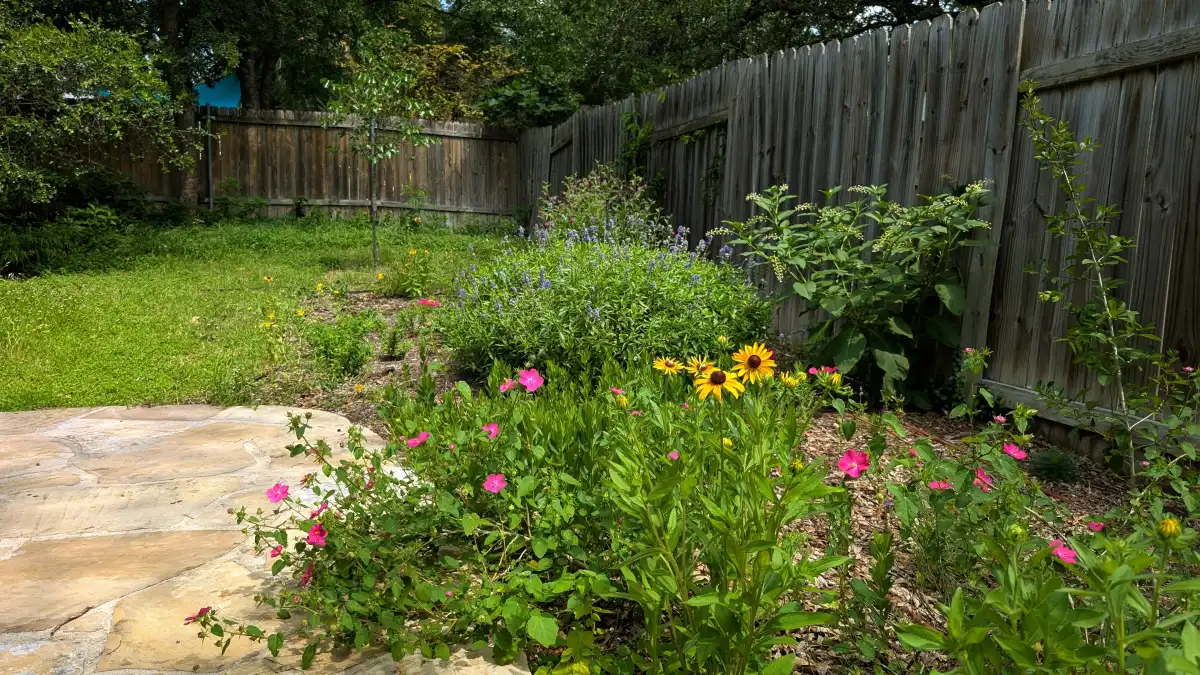
A plant is not a plant is a plant
When choosing plants for your garden, it is important to be aware of the distinction between native and non-native plants. In the US, a plant that has been endemic to the region prior to European settlement is a native plant. Non-native species are plants that were introduced by humans from other regions.
Non-native plants may be
- Non-adapted: Plants that are not adapted to the local climate and soil
- Adapted: Plants that originated elsewhere, but thrive in the local climate and soil
- Invasive: Plants that thrive too well in the local climate and soil, and outcompete native plants
Non-native species include turf grasses like St. Augustine and Bermuda grass.
Native plants can help your yard come alive
Turf grass that is kept mown, raked and weeded is essentially a green dead zone, and cannot support wildlife1. What might not be obvious is that the plants that you choose for your garden can make a difference in how much wildlife you can attract and support, and growing flowers for pollinators is just part of the equation.
Everyone needs bugs
To help native wildlife, you must start with insects. Insects have the following key roles to play:
- pollinate plants
- decompose dead plant matter, which enriches the soil
- prey on other insects and keep the insect population balanced
- be eaten by birds and their young
Nestlings in particular almost exclusively subsist on insects. A single nest of chickadees requires more than 5000 caterpillars to successfully raise one brood2. So while bird feeders might help adult birds, they don’t feed nestlings.
Bugs need native plants
Insects need at least two kinds of plants to survive and reproduce:
- host plants that support them in the larval stage
- pollinator plants that supply nectar and pollen
For example, butterflies and moths lay their eggs on host plants, and the caterpillars feed on the plants after hatching. After they metamorphose into adults, they feed on nectar from pollinator plants. If you want to support insects, you need both host plants and pollinator plants in your garden.
It is as host plants that native plants outshine adapted plants in their utility. The vast majority of North American caterpillars can only feed on a small number of specific plants that they have co-evolved with, and a loss of native host plants is leading to declining insect populations2.
Many native host plants are also great pollinator plants, thus serving a dual purpose.
A note — in cases where a host plant has different varieties in different regions, the safest choice is to grow the native variety. For example, monarch butterflies famously need milkweed to reproduce. If you are in Texas, you should grow milkweeds that are native to Texas, and not tropical milkweed, because non-native milkweed may be causing monarchs to change their migratory patterns in undesirable ways, and may be increasing the spread of a parasitic disease in the population3.
Bugs and berries bring birds
Native plants are the best kind of bird feeder4. Birds seem to prefer native berries for their more nutritious content than non-native berries5. Cardinals, finches, chickadees, wrens, mockingbirds, and others flock to the Plant Bat Habitat to eat seeds and berries. Hummingbirds are also constant visitors, attracted by these hummingbird magnets.
Native plants can help slash your water bill
The Plant Bat Habitat has about 4500 sq ft of yard space. Turf grass of this size would need over 100,000 gallons a year to stay lush and green throughout the year6. By contrast, native plant beds might need up to 10,000 gallons a year. The cost savings on the water bill comes out to $150-$200 a month. In addition, the City of Austin offers rebates for converting turf grass to native plant beds.
Native plants are low maintenance
Native plant beds allow you to skip the mowing, blowing, raking, fertilizers, herbicides and pesticides. Once established, they naturally suppress weeds when planted densely, or when groundcovers are used. Texas natives are well adapted to our extreme climate, and won’t need protection during freezes.
Native plant beds also require less maintenance than stone/gravelscapes.
Replacing turf grass with stone/gravelscapes might be tempting because they can look attractive, and you don’t have to run any irrigation. A word of caution though, stonescapes involve more work than you might think. Austin gets so much rainfall that weeds quickly pop up and can take over a stonescape. Landscape fabric is not effective at suppressing weeds over the long run. Leaves and other organic matter collect on the rocks and have to be blown away. Stonescapes have no ecological benefit. They absorb heat and increase local temperatures7. It’s a lot of labor to add a stonescape, and more labor to remove it if you change your mind.
However, none of this means you should eschew stonescapes completely. They just work better as accents rather than a wholesale replacement for turf.
Native plants can’t hurt the local ecosystem
Even the most aggressive, megalomaniacal Texas native knows its place in the ecosystem, and will not disrupt nature’s balance. Invasive plants, on the other hand, escape cultivation, outcompete natives, create monocultures, and reduce biodiversity8. Examples of invasives that are readily available and commonly used in Austin are:
- Bermuda grass
- Nandina
- Privet
- English Ivy
- Some Lantana species
- Bradford Pear
- Chinese Pistache
- Vitex
Before you buy, you can look up the plant’s scientific name on a database, like this one from NPSOT. If the plant pops up on the list, the website suggests native alternatives that you can opt for instead.
Native plants are the land’s language
When speaking about natural beauty, Lady Bird Johnson said “I want Texas to look like Texas, and Vermont to look like Vermont… I just hate to see the land homogenized”9. And she’s right. Let’s become native to our place10.
How do I know if a plant is native?
Look up the plant’s scientific name on the Wildflower Center Database. Texans can use the NPSOT Database, which also shows the regions within Texas that the plant is endemic to.
Where can I buy native?
Big box stores (and many local nurseries) won’t have a good selection of native plants. Look for local nurseries that specialize in natives. For those who live in Austin, I recommend the Barton Springs Nursery in South Austin and the Greensleeves Nursery in Pflugerville.
My favorite place for acquiring native plants is the Lady Bird Johnson Wildflower Center. They have annual Spring, Fall and Winter sales, and offer a wide selection of beautiful plants that
- are larval hosts and pollinator friendly
- have seeds and berries
- provide nesting and hiding places
You can also purchase seeds at Native American Seed (only native seeds) or the Wildseed Farms (native and non-native available).
References
-
https://www.npsot.org/posts/invasives-choose-native-over-tropical-milkweed/ ↩
-
https://www.wildflower.org/magazine/native-plants/skip-bird-feeder ↩
-
https://www.nwf.org/Magazines/National-Wildlife/2021/Feb-Mar/Gardening/Native-Berries ↩
-
https://www.austintexas.gov/water/water-wise-landscaping-rebate-faqs ↩
-
https://www.roundrocktexas.gov/water-spot/2022/08/dont-rock-your-landscape/ ↩
-
https://www.npr.org/templates/story/story.php?storyId=11664985 ↩
-
Slogan of the Native American Seed company https://seedsource.com/ ↩